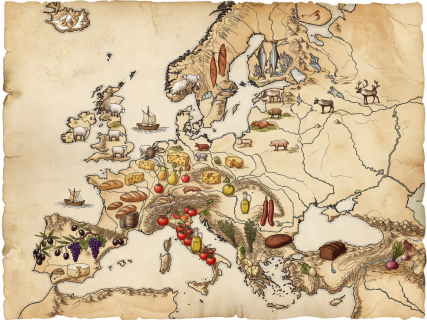
Modern national borders rarely capture how food truly works. Instead, European cooking follows river valleys, mountain barriers, historical trade routes, and soil types.
SOUTHERN BASIN
1. Mediterranean Europe & The Iberian Peninsula
The Mediterranean basin shares an agricultural blueprint dominated by three ancient pillars: the olive tree, wheat, and the grape vine. Sunshine is plentiful, winters are mild, and summers are dry. Consequently, cooking in Southern Italy, Greece, coastal Spain, and Portugal prioritizes raw freshness, ripe tomatoes, garlic, legumes, and cold-pressed extra virgin olive oil.
In the Iberian Peninsula (Spain and Portugal), centuries of Moorish presence introduced rice cultivation, saffron, almonds, citrus groves, and complex spice layering. Atlantic Portugal adds heavy reliance on salt cod (bacalhau), maritime stews, and charcoal-grilled sardines, whereas inland Spain relies heavily on dry-cured pork (jamón), paprika (pimentón), and rustic bean pots.
Key Defining Traits: Olive oil frying, fresh herbs (oregano, rosemary, thyme), seafood abundance, sun-ripened produce, and light citrus acidity.
TERROIR & DIVERSITY
2. France & The Great Agricultural Plains
France is unique because it sits squarely at the crossroads of Northern butter culture and Southern olive culture. In Normandy and Brittany, cool coastal rains produce rich pastures for dairy cattle, making cultured butter, heavy cream, apples, and buckwheat pancakes dominant. In Provence and the Côte d'Azur, cooking shifts entirely to olive oil, capers, anchovies, eggplant, and courgettes.
Central French valleys (like Burgundy and the Loire) built sophisticated slow-cooking traditions using regional wine marinades to tenderize meats (Boeuf Bourguignon), while the mountainous southwest leans on duck fat, goose preservation (confit), and white haricot beans.
CONTINENTAL HEARTLAND
3. Central Europe & The Alpine Region
Central Europe—spanning Germany, Austria, Switzerland, Poland, the Czech Republic, Slovakia, and Hungary—experiences colder winters and shorter growing seasons. The cuisine is engineered for sustained caloric energy, featuring root vegetables, brassicas (cabbage, kale), pork, smoked sausages, dumplings, and rye bread.
The Alpine zone (Swiss, Austrian, Bavarian, and Northern Italian Alps) developed master-level dairy preservation. High-altitude summer pastures yield hard, long-aging cheeses (like Gruyère, Emmental, and Comté) designed to survive harsh winter isolations. Dishes here celebrate melted cheese, polenta, buckwheat noodles, and cured mountain meats.
Further east across the Pannonian Basin, Hungarian cuisine stands apart through its historic adoption of ground capsicum peppers (sweet and hot paprika), layered sour cream, and slow-braised stews.
COASTAL & FORAGED
4. Scandinavia, The Baltic & The British Isles
In the far north, long daylight hours in summer give way to freezing dark winters. Scandinavian and Baltic culinary cultures mastered wood-smoking, brine-curing, pickling, and lactic fermentation. Herring, salmon, dill, sour cream, dark dense sourdough rye, and foraged wild berries (lingonberries, cloudberries) are core staples.
The British Isles, warmed by the North Atlantic Drift, benefit from exceptionally lush pastureland and cold maritime seas. The cuisine focuses on world-class beef and lamb rearing, legacy farmhouse cheddars, savory meat pies, root vegetable mashes, and deep-fried fresh Atlantic fish paired with malt vinegar.
CROSSROADS & SPICE
5. The Balkans & Eastern Europe
The Balkan Peninsula sits where Central European farming intersects with Byzantine and Ottoman trade history. Charcoal grilling of spiced minced meats (Ćevapi), layered filo dough pastries (Burek), pickled cabbage heads (Sarma), and salted sheep cheeses define the dinner table.
Eastern Europe (Ukraine, Romania, Moldova, Poland) relies heavily on beetroot, fermented rye sourdough starters, wild forest mushrooms, sauerkraut, and dill. Beet soups like Borscht illustrate how earth-sweet roots are balanced with bright vinegar or sour cream acidity.